Before you can play your first game of chess, you need to know how to set up the board. It sounds simple, and it mostly is, but there are a few details that trip people up every single time. The queen goes where? The board faces which way?
This guide walks you through the complete chess board setup, piece by piece, so you get it right from the start.
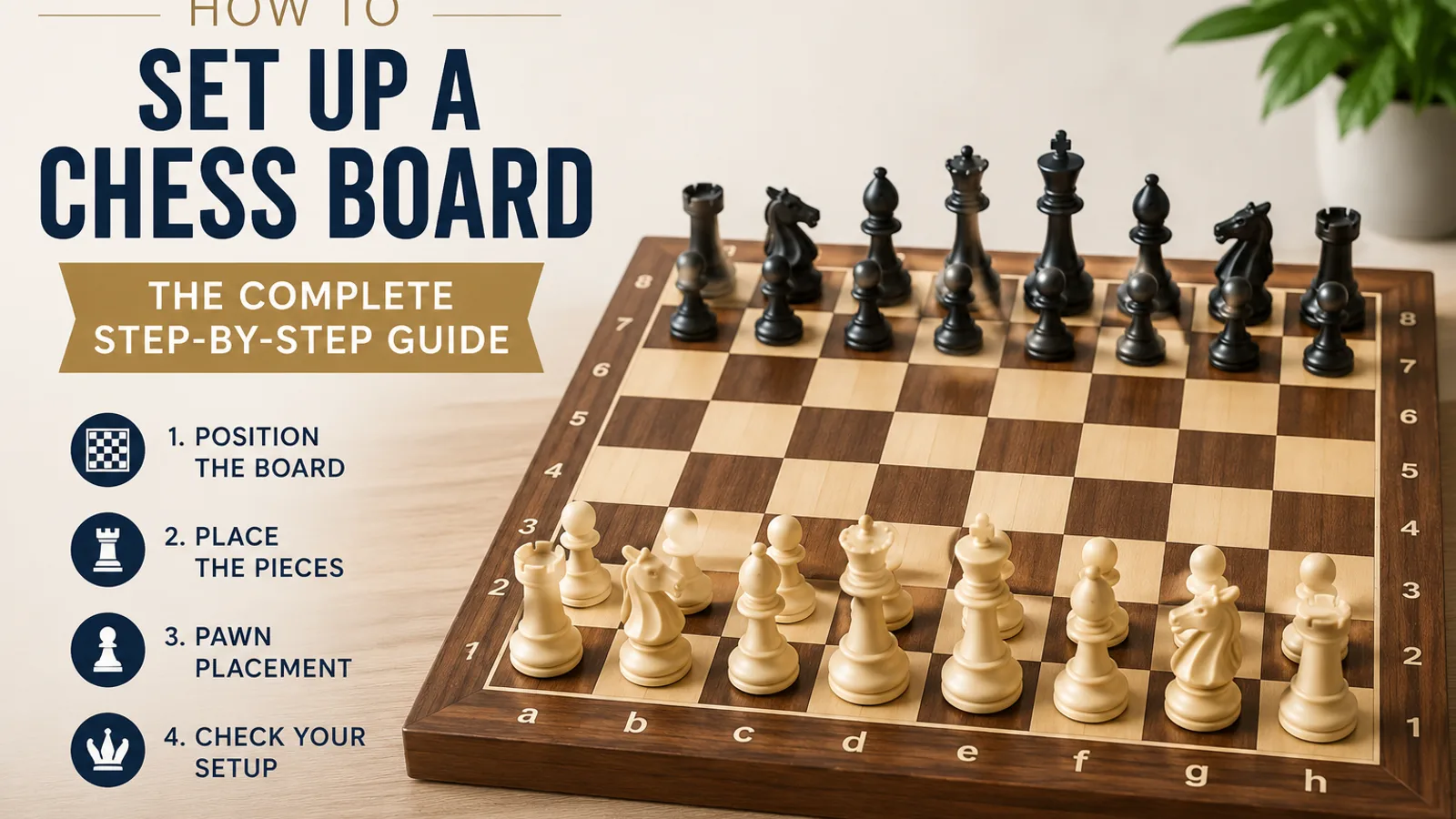
Step 1: Orient the Board
This is the step most people skip, and it's the one that matters first.
Place the board so that each player has a light (white) square in their bottom-right corner. That's it. If the bottom-right square is dark, rotate the board 90 degrees.
It seems like a small thing, but if the board is rotated, every piece ends up on the wrong color square. The whole game is off. Tournaments will make you fix it. So get this right before you touch a single piece.
Step 2: Place the Rooks (Corners)
The rooks go in the four corners of the board. Two white rooks on White's back row (a1 and h1), two black rooks on Black's back row (a8 and h8).
Rooks look like castle towers, which is why some people call them "castles." (The official name is rook, though.)
Step 3: Place the Knights (Next to the Rooks)
The knights go right next to the rooks. They're the horse-shaped pieces, and they're the only chess pieces that aren't symmetrical, so they look a bit different from every angle.
Place one knight on each side, just inside the rooks. For White, that's b1 and g1. For Black, b8 and g8.
Step 4: Place the Bishops (Next to the Knights)
The bishops go next to the knights. They're the tall, pointed pieces with a slit near the top (that's supposed to represent a bishop's mitre, the ceremonial hat).
For White: c1 and f1. For Black: c8 and f8.
Notice something: one bishop sits on a light square, the other on a dark square. This is by design. Each bishop stays on its own color for the entire game, so they cover different territory. You'll hear players say "light-squared bishop" and "dark-squared bishop" and now you know why.
Step 5: Place the Queen (On Her Own Color)
Here's where most setup mistakes happen.
The queen goes on the remaining center square that matches her color. White queen on the light center square (d1). Black queen on the dark center square (d8).
If you forget this rule and swap the queen and king, the entire game will feel wrong, and you won't realize why until someone points it out. Queen on her color. Say it twice if you need to.
Step 6: Place the King (The Remaining Square)
The king goes on the last empty square in the back row, right next to the queen. For White, that's e1. For Black, e8.
The king is usually the tallest piece on the board, often with a cross on top. If your set doesn't have a cross, the king is the one that's slightly taller than the queen (and sometimes narrower).
Step 7: Place the Pawns (The Entire Second Row)
The pawns fill up the entire second row for each player. Eight pawns per side. White pawns on row 2, black pawns on row 7.
Pawns are the smallest pieces on the board, and they're the ones you have the most of. They might look unimportant, but they're not. Pawns control space, create structure, and if one makes it all the way to the other side of the board, it can promote to any other piece (usually a queen). Pawn play is a huge part of chess strategy.
That's it. Your board is set up and ready to play.
Watch the moves play out below. The sequence loops automatically — pause anytime.
Chess Piece Names and How They Move
Now that every piece is in place, here's a quick reference for what each piece is called and what it does. Think of this as your cheat sheet for the first few games.
King — Moves one square in any direction. The most important piece on the board (lose him and the game is over), but also the least mobile. Your whole game revolves around keeping him safe.
Queen — Moves any number of squares in any direction (horizontal, vertical, or diagonal). The most powerful piece. She combines the rook's and bishop's movement into one.
Rook — Moves any number of squares horizontally or vertically. Rooks are strongest in the endgame when the board opens up. They're also involved in castling, a special move worth learning early.
Bishop — Moves any number of squares diagonally. Remember, each bishop is locked to its starting color for the entire game. A pair of bishops working together covers the whole board.
Knight — Moves in an L-shape: two squares in one direction and one square perpendicular (or vice versa). The knight is the only piece that can jump over other pieces, which makes it tricky and unpredictable, especially in crowded positions.
Pawn — Moves forward one square at a time (or two squares on its very first move). Pawns capture diagonally, one square forward-left or forward-right. They also have a special capture called en passant, which is one of those rules that surprises everyone the first time they see it.
Common Chess Board Setup Mistakes
Even people who've been playing casually for years get caught by these.
If you don't have a light square in the bottom-right corner, everything is on the wrong color. Check before you set up.
This is the most common mistake. Remember: queen on her color. White queen on the white square, black queen on the black square.
Bishops go next to the queen and king (closer to the center). Knights go next to the rooks (closer to the edges). If your knights are in the bishop spots, your bishops will be on the wrong color squares too, and that changes the whole game.
Each player's pieces go on the two rows closest to them, not the two rows farthest away. You'd be surprised how often this happens when kids are learning.
Pawns go on the second row, not the first. The back row (closest to each player) is for the major and minor pieces.
What Comes Next
You've got the board set up. That's step one. Step two is learning how to actually play well, and the good news is that a handful of basic principles will take you surprisingly far. Things like controlling the center, developing your pieces early, and keeping your king safe will win you more games than any complicated opening memorization.
Or, if you want to practice reading the board and spotting patterns, give our chess puzzles a try. Nothing builds chess intuition faster than solving a few puzzles a day.
You know where everything goes now. Time to play.